26 Sep 2026
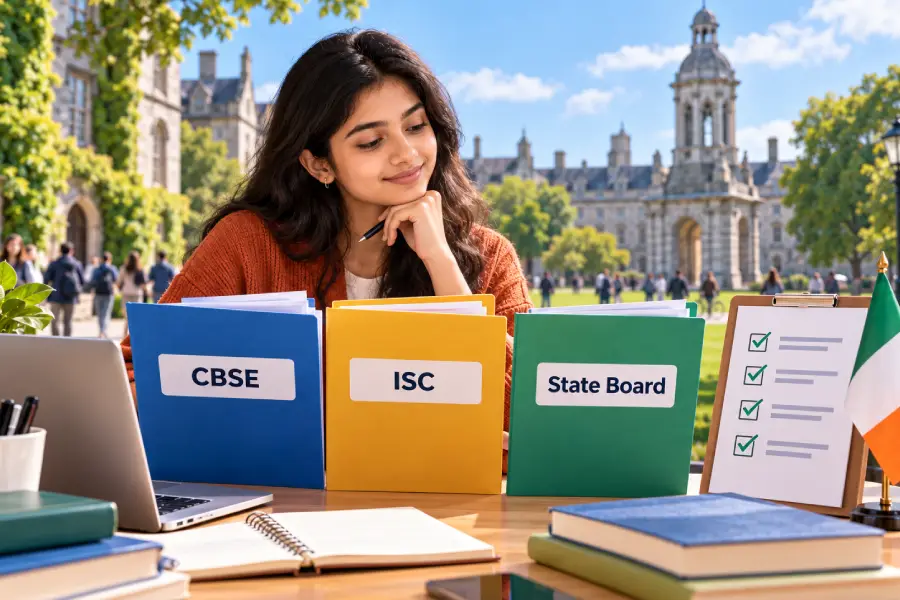
Can you study in Ireland straight after Class 12? For many Indian students, the answer is yes. Irish universities consider applications from CBSE, ISC (CISCE) and recognised state boards for undergraduate degrees.
The part that needs careful checking is the course requirement. A university may accept your board but still require a particular overall percentage, a strong mark in Mathematics or Science, or separate proof of English proficiency. There is no single Class 12 cutoff that applies across Ireland.
This guide explains what students from each board should check before applying and how to prepare a stronger application.
Yes, several Irish universities explicitly recognise Indian school qualifications. University of Galway lists CBSE, CISCE and state boards for undergraduate entry. University College Cork (UCC) and Dublin City University (DCU) also list qualifications from all three. Recognition makes you eligible to be assessed; it does not guarantee a place on your chosen course.
| Your Class 12 board | What Irish universities may assess | What to check before applying |
|---|---|---|
| CBSE | Your overall Class 12 result, relevant subject marks and English qualification | How the university calculates your average and whether your course requires specific subjects |
| ISC (CISCE) | Your Indian School Certificate results and course-specific subjects | Whether English marks meet the university’s language rule |
| State board | Your recognised board’s Higher Secondary or Standard XII results | Whether that university accepts your board for the course and what English evidence it requires |
A useful example of why the details matter: UCC calculates its Indian entry average from the best five recognised subjects and asks applicants to provide Class 10 results as well. Another university may use a different method.
The required percentage depends on the institution and programme. Published requirements illustrate the range:
CBSE students can apply to Irish undergraduate programmes where the university recognises the All India Senior School Certificate. Your Class 12 percentage is important, but universities may also examine the subjects behind that percentage.
Before choosing a course, check:
For example, DCU says CBSE applicants can meet its English requirement with 80% in Class 12 English, or by presenting an approved English language examination. That is DCU’s rule; it should not be assumed to apply to every Irish university.
Irish universities commonly refer to the ISC qualification under the name CISCE Indian School Certificate. As with CBSE, your eligibility depends on the programme’s overall and subject-specific requirements.
An ISC student interested in business, humanities or computing should check the requirements for each course separately. Having a qualifying overall score does not necessarily replace a required Mathematics mark. DCU, for instance, specifies that programme-specific subject grades must be presented at Class 12 level.
ISC English may help with language eligibility at some universities. DCU accepts 80% in Class 12 English from CISCE for its English requirement, with approved English tests available as an alternative. Check your chosen university’s own policy before deciding whether you need a test.
Studying under a state board does not, by itself, prevent you from applying to Ireland. University of Galway, UCC and DCU all include recognised state board qualifications in their published Indian undergraduate guidance.
State board applicants should pay particular attention to English language evidence. A university may accept your board marks for academic admission while asking for a separate approved English test. DCU’s published Class 12 English route, for example, specifically names CBSE and CISCE; its alternative is an approved English examination.
It is also sensible to check how the university verifies results. University of Galway currently requires official DigiLocker verification of Standard XII grades and certificates from Indian applicants.
Not in every case, but do not assume a waiver. English language rules differ by university and course. Some institutions accept specified Indian Class 12 English results; others require an approved test or apply additional conditions.
For instance, Trinity College Dublin requires applicants to provide official evidence of English proficiency and directs students to the relevant course page for its exact requirement. DCU publishes a qualifying Class 12 English score for CBSE and CISCE applicants and also accepts approved English examinations.
Check the university admission requirement and the applicable visa guidance before booking a test or relying on your school English mark. Education Ireland notes that institutions may set additional English requirements.
Two students with the same Class 12 average may qualify for different degrees because they studied different subjects. A course can set minimum grades or require a subject you must have taken in Class 12.
When comparing programmes, look for requirements relating to:
UCC states that programmes can have specific subject, interview or portfolio requirements. Trinity’s India guidance also sets minimum matriculation conditions involving Mathematics and a language other than English up to Grade X. The safest approach is to read both the India entry page and the individual course page.
Each institution will provide its own application checklist. Preparing these documents early can make it easier to meet a deadline or respond to an offer:
Check that your name and date of birth are consistent across your school records and passport. Where the university requests official result verification, follow its instructions rather than uploading an unofficial copy alone.
Depending on the institution and application timing, you may receive a conditional offer. This means you still have to satisfy conditions such as submitting final examination results or other documents before admission is confirmed. Education Ireland advises applicants to review those conditions carefully when responding to an offer.
If you are currently in Class 12, start by shortlisting courses and checking their entry rules. That gives you time to prepare documents and, if necessary, take an English language test.
A foundation route may be worth exploring if you do not meet the direct entry criteria for your preferred degree. It must be checked against both the provider’s progression conditions and your intended university course.
For example, University of Galway publishes a foundation-level Class 12 threshold separately from its undergraduate entry bands. Trinity College Dublin also offers an International Foundation Programme for students who cannot begin an undergraduate degree directly. A foundation offer is a separate pathway, so confirm exactly what results you must achieve to progress.
For Indian students, the strongest application starts with four checks: Is your board accepted? Do your marks meet the course threshold? Do you have the required subjects? How will you prove your English proficiency?
At Ireland Study Consultants, we can help you compare undergraduate options against your CBSE, ISC or state board results, understand offer conditions and organise the next steps in your application. Start with your preferred course and your actual marks; that is more useful than relying on a general “minimum percentage for Ireland.”
The Ireland Study Consultants team specialises in helping Indian students plan their education in Ireland. With a focus on undergraduate admissions, they help CBSE, ISC and state board students understand course requirements, compare universities and prepare their applications. Their guides draw on published university and Irish government information to give students clear, practical advice.
Copyright © 2026 Ireland Study Consultants. All rights reserved
 info@irelandstudyconsultants.com
 +91-92668 42936


